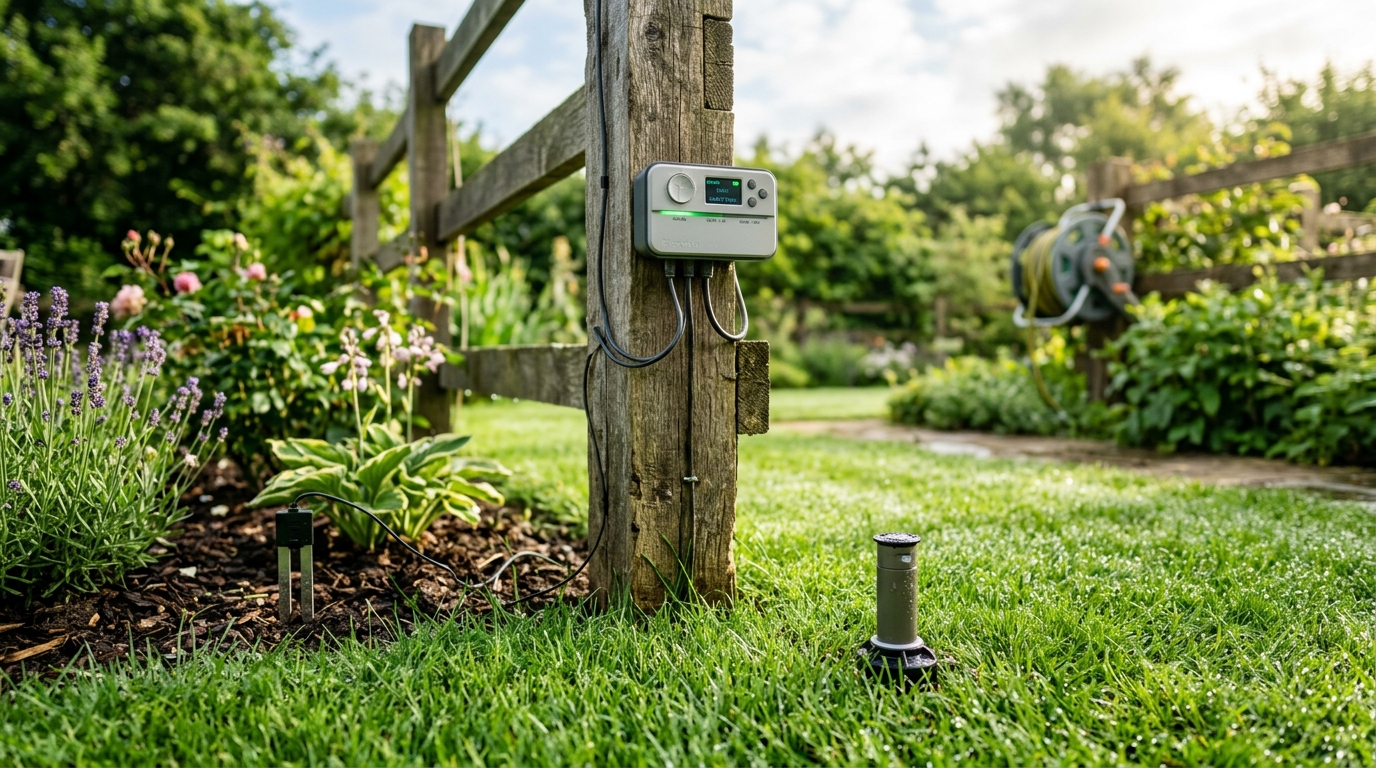

Quick answer if you’re in a hurry: the gap between a basic Wi-Fi sprinkler timer and a premium smart irrigation system has widened noticeably this year — mostly because of zone-by-zone precision, not because premium brands added more bells and whistles. Here’s what that money actually buys you, and who should skip it.
The Case for Going Premium
Water-saving irrigation this year isn’t about a single flashy new nozzle — it’s about how systems combine drip lines, micro-sprinklers, and sensor feedback to cut down on evaporation, runoff, and clogging all at once. That combination is exactly where entry-level controllers start to fall short. A $40 Wi-Fi timer can turn a sprinkler on and off remotely, but it generally can’t tell you that one zone is sandy and drains fast while another is clay-heavy and stays waterlogged for a day after every cycle.
That’s the real argument for premium hardware: zoning precision, not remote control. Different soil textures, slopes, and sun exposure levels genuinely don’t need the same runtime, and a properly zoned system can run shorter cycles in shaded areas and longer ones in sun-baked, sandy patches — automatically, without you manually reprogramming anything every season.
Three Systems Worth Comparing
Rachio 3 Smart Bundle — Currently the most recommended all-around option for most yards, largely because of its 8-zone control and app experience that doesn’t require an engineering degree to configure. If you’ve got a fairly typical residential yard with a handful of distinct zones (front lawn, back lawn, flower beds, maybe a garden strip), this tends to be the one people land on without much buyer’s remorse.
Hunter PRO-HC WiFi Controller — Built for bigger properties, supporting up to 24 zones. This one’s overkill for a typical suburban lot, but if you’re managing a larger property, multiple garden areas, or a mixed residential-commercial space, the zone ceiling on cheaper controllers becomes a real limitation fast.
Rain Bird OTO — The pick if solar power and weather-adaptive scheduling matter more to you than raw zone count. It leans into being genuinely eco-conscious rather than just “smart,” adjusting watering automatically based on real weather data rather than a rigid preset schedule.
The honest trade-off across all three: premium systems cost more and take longer to set up properly, since you’re configuring real zone data instead of just pairing a device to Wi-Fi. That complexity is the price of the precision.
The Bigger Trend Behind the Premium Push
This isn’t happening in a vacuum. Money is moving into this space at a pace that suggests the industry expects serious long-term demand — Moleaer’s partnership with water-infrastructure giant Xylem, combined with smaller moves like Lumo’s expansion into precision irrigation and a $6.5 million seed round for retrofitted irrigation automation, all points to smart irrigation being treated as core infrastructure now, not a hobbyist gadget category. Even the FAO has started treating farm-level water-use data as a food-security planning requirement rather than an optional efficiency nicety, which says something about how seriously water precision is being taken well beyond backyard gardens.
For homeowners, the practical trickle-down is faster iteration on consumer-grade hardware and better filtration and pressure-regulation tech showing up in mid-range products that used to only exist at the commercial level.
Do You Actually Need Premium, Though?
Honestly — not always. If your yard is small, relatively uniform in soil type and sun exposure, and you’re mainly trying to stop watering during rainstorms, a basic smart controller with rain-delay and app control will get you most of the benefit for a fraction of the price. Premium zoning really earns its cost when your yard has genuinely different microclimates: sun versus shade, clay versus sandy soil, a vegetable bed next to an ornamental lawn.
The clearest signal it’s time to upgrade: if you’ve caught yourself manually overriding your current system’s schedule more than once or twice a month because “that one zone is always too wet” or “that corner never gets enough water,” that’s precisely the problem zone-based premium controllers are built to solve.