Smart lighting has quietly picked up a second job: watching your yard. Floodlights used to switch on whenever a moth flew past. Now many of them carry a camera and an AI chip, and they decide for themselves what deserves a blast of light. I spent a week reading test results and spec sheets to see who is doing this well. The most interesting trend is not brightness. It is the death of the monthly fee.
Why the Light and the Camera Finally Merged
For years, I treated lighting and cameras as two separate shopping trips. One handled the glow. The other handled the footage. That split made little sense once I thought about it. A camera sees more when the light is good, and a light is smarter when the camera tells it what happened.
Manufacturers noticed the same thing. Consumer Reports now tests floodlight cameras as their own category. Its lab results praise several models for sharp video and fast response times. So buyers no longer need to stitch two products together.
Local AI Is the Real Upgrade
Here is the part that surprised me. The best new models run their AI on the device itself. Nothing has to travel to a cloud server first.
Take Reolink’s Elite Floodlight WiFi. According to coverage on Yahoo Tech, it sells for about $199.99. It reaches up to 3,000 lumens. It also offers local video search without a subscription. In plain terms, you can find a past event by describing it, and the footage never leaves your home.
Wyze takes a similar approach with its Floodlight Pro. The company says the lights switch on only for objects you pick, such as people and vehicles. That means a passing cat should not trigger the floodlights at 2 a.m. As someone who once got woken by a hedgehog, I find that detail very appealing.
Solar Changes the Install
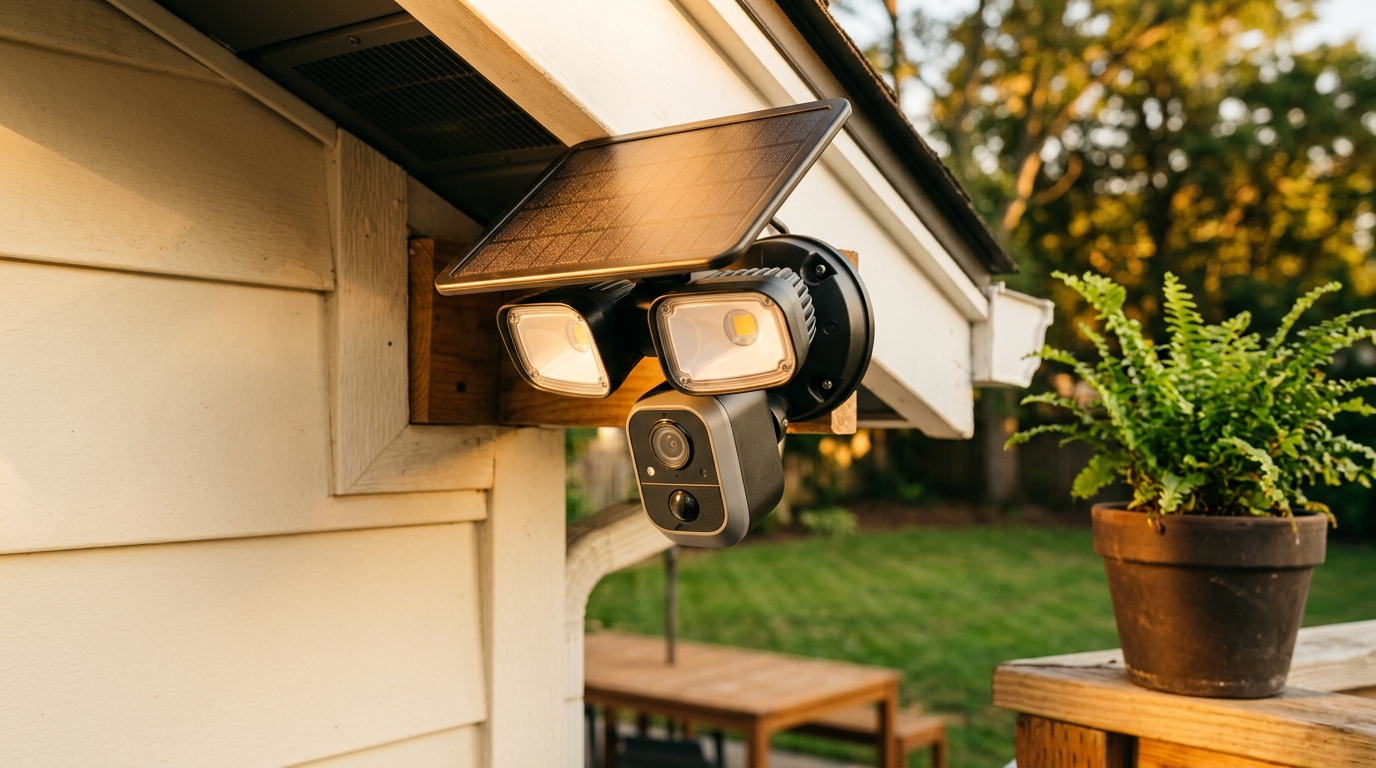
Wiring a floodlight is the step that scares most renters and plenty of owners. Solar models remove it. T3 reported in April that Reolink launched a Solar Floodlight Camera with an integrated solar panel. It records in 2K and includes a siren. It also carries no subscription cost.
That combination matters. You can mount it on a fence post or a shed wall. You skip the electrician. You also avoid the monthly bill that quietly doubles the real price of many cameras.
Four Floodlight Cameras Worth a Look
Every home is different, so I grouped these by the problem they solve.
For wide coverage, look at the Eufy Floodlight Camera E30. It pans and tilts through 360 degrees and tracks people and vehicles with AI. A recent buying guide also notes it charges no monthly fee. Consumer Reports rated its video quality and response time very highly.
For a no-wiring setup, the Blink Outdoor 4 Floodlight is the easy path. It runs wire-free and promises long battery life. However, its light is gentler, at roughly 700 lumens. I would use it for motion-triggered lighting, not for illuminating a whole work area.
For the brightest beam, consider the Wyze Floodlight Pro. It offers 3,000 lumens and a 180-degree view. It also leans on AI to cut false alarms.
For a mix of solar power and local AI, watch Reolink. Its solar and Elite models both skip subscriptions. Prices will vary by region, so check current listings before you buy.
The Privacy Catch
Not everything here is rosy. Consumer Reports found that data privacy scores were weak for several floodlight cameras, including the Blink Wired model. The group described this as a common problem across brands.
So read the privacy settings before you mount anything. Turn off cloud sharing you do not need. Update the firmware as soon as the app asks. Also use a strong, unique password. These steps take ten minutes and cover most of the risk.
How I Would Choose
Start with your power situation. If you have a wired fixture, a wired model gives you the most light and the fewest chores. If you do not, go solar or battery.
Next, decide how much you care about subscriptions. If you hate recurring fees, favor models with local AI storage. Finally, think about coverage. A yard with several approaches suits a pan-and-tilt camera better than a fixed one.
Smart lighting will keep absorbing security features. That is good news for buyers. You get more protection from fewer devices, and increasingly you pay once. Just remember that a brighter yard only helps if the camera behind it respects your privacy.