Water-wise garden design: how to save water while growing is one of the most important gardening skills of the coming decade — and not just for homeowners in drought-prone climates. With water prices rising sharply across the U.S., Europe, and beyond, and with increasingly unpredictable rainfall patterns affecting even traditionally wet regions, every gardener now has a financial and practical reason to think carefully about water use.
The average American household uses around 320 gallons of water per day, and outdoor watering — primarily gardens and lawns — accounts for up to 30 percent of that total. In summer months, that proportion rises dramatically. Many homeowners water their gardens inefficiently, losing large amounts to evaporation, runoff, and overwatering — plants that are drowning receive as little benefit as those that are parched.
The good news is that water-wise gardening is not about sacrifice. It is not about replacing your garden with gravel and cacti. It is about understanding how water moves through your garden, choosing plants that thrive in your conditions rather than fighting them, and applying water where and when it does the most good. The result is often a more beautiful, more resilient, and significantly cheaper garden to maintain.
The Seven Principles of Water-Wise Garden Design
Water-wise design is built on seven interconnected principles, developed and refined over decades of horticultural research and real-world gardening experience. Together, they form a complete system — each principle reinforcing the others. You do not need to implement all seven at once. Even applying two or three will produce a measurable difference in your water use and your garden’s resilience.
Principle 1: Start With the Soil
The foundation of every water-wise garden
The single most impactful investment you can make in a water-wise garden is improving your soil — before you plant a single thing. Well-structured soil acts like a sponge, absorbing rainfall and irrigation water efficiently, holding it in reserve for plant roots, and releasing it gradually over time. Poor soil — either too sandy (water drains straight through) or too clay-heavy (water sits on the surface and runs off) — wastes water regardless of how efficiently you apply it.
The universal fix for both extremes is the same: organic matter. Compost, well-rotted manure, leaf mould, and worm castings all improve soil structure dramatically — opening up clay soils to allow better drainage, and binding sandy soils to improve water retention. For most gardens, digging in a 3–4 inch layer of compost before planting, and topdressing established beds with compost annually, transforms the soil’s water-holding capacity within one to two seasons.
A simple soil test (available at garden centres for $10–$20) tells you your soil pH and basic nutrient levels, helping you choose the right amendments for your specific conditions. Healthy soil biology — the network of fungi, bacteria, and microorganisms that live in well-composted soil — further improves water efficiency by creating channels that help water penetrate deeply rather than running off the surface.
- Sandy soil: Add generous amounts of compost and consider a clay amendment like biochar to improve water retention
- Clay soil: Add compost and horticultural grit to improve drainage and prevent waterlogging and surface runoff
- Loam soil: Maintain organic matter levels with annual compost topdressing — even good soil degrades over time without replenishment
Water saving potential
Up to 70%
Principle 2: Mulch Everything, Always
The easiest high-impact change you can make today
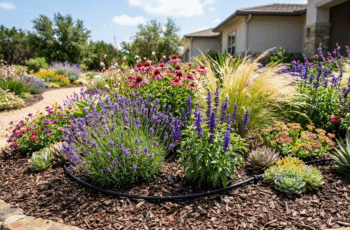
Mulching is the single most cost-effective water-saving technique available to any gardener, and it is remarkable how many homeowners still skip it. A 3–4 inch layer of organic mulch — wood chips, bark, straw, composted leaves, or cocoa shells — applied over the soil surface around plants dramatically reduces surface evaporation, suppresses weeds that compete with plants for water, moderates soil temperature, and gradually breaks down to improve soil structure.
Studies consistently show that a 4-inch layer of mulch reduces soil water evaporation by 50 to 70 percent compared to bare soil. In practical terms, this means the same rainfall or irrigation event waters your garden for two to three times longer than it would without mulch. You do not need to water as often, and your plants suffer less stress between watering events.
Apply mulch in late spring, after the soil has warmed up but before the main dry period begins. Keep mulch a few inches away from plant stems and tree trunks to prevent rot. Top up the mulch layer annually — it decomposes into the soil over the course of the year, which is beneficial for soil health but means the layer needs replenishing each season.
- Wood chips / bark: Long-lasting, widely available, excellent for shrub and tree borders
- Straw: Ideal for vegetable gardens — keeps soil cool and moist, easy to remove at season end
- Composted leaves (leaf mould): Free if you collect your own, excellent fine mulch that improves soil as it breaks down
- Gravel / pebbles: Inorganic mulch that does not break down — good for Mediterranean-style planting but does not improve soil
Water saving potential
Up to 60%
Principle 3: Choose the Right Plants
The right plant in the right place needs less water permanently
The most elegant form of water-wise gardening requires no ongoing effort at all: choose plants that are naturally adapted to your climate and soil conditions, and they will largely look after themselves once established. Plants that are suited to their growing conditions develop deeper, more extensive root systems, are more efficient at accessing soil moisture, and tolerate dry periods without stress. Plants fighting unsuitable conditions are permanently thirsty, no matter how much you water them.
This does not mean your garden needs to look like a desert. Drought-tolerant planting can be extraordinarily beautiful — the Mediterranean garden, the prairie-style planting, the South African-inspired border, the California native garden — these are some of the most striking styles in contemporary garden design, and they all share the principle of working with natural conditions rather than against them.
When selecting plants for a water-wise garden, look for: grey or silver foliage (the colour reflects light and reduces water loss); narrow, waxy, or hairy leaves (adaptations that reduce transpiration); aromatic herbs (the essential oils in their leaves reduce evaporation); and native plants from your region (evolved to survive your specific rainfall patterns).
Water saving potential
Up to 80%
Principle 4: Water Smarter, Not More
When, how, and where you water matters as much as how much
Most homeowners water their gardens at the wrong time, in the wrong way, and in the wrong quantities. Correcting these three habits alone can reduce outdoor water use by 30 to 50 percent without changing a single plant or adding any new infrastructure.
Water in the early morning. This is the single most effective timing change you can make. Early morning watering gives plants time to absorb water before the heat of the day, reduces the amount lost to evaporation (which is highest between midday and late afternoon), and means foliage dries quickly, reducing fungal disease risk. Evening watering is the second-best choice. Midday watering is the worst — studies show that up to 30 percent of water applied at midday is lost to evaporation before it reaches the root zone.
Water deeply and infrequently. Frequent shallow watering encourages plants to develop shallow root systems that are vulnerable to drought. Deep, infrequent watering — soaking the soil to a depth of 8–12 inches once or twice a week rather than a light sprinkle every day — encourages plants to develop deep root systems that can access moisture from lower in the soil profile. Deep-rooted plants are dramatically more drought-tolerant and require far less irrigation to thrive.
Water the roots, not the leaves. Water applied directly to the soil at the base of plants reaches the root zone where it is needed. Water applied overhead via sprinklers loses a significant proportion to evaporation and wets foliage unnecessarily, increasing disease risk. A simple soaker hose laid along the base of a border delivers water directly to the root zone at low pressure, eliminating both evaporation loss and wet foliage — and can reduce water use by 40 percent compared to overhead sprinklers.
- Best time to water: 5–9 AM (early morning)
- Acceptable alternative: Evening, after the hottest part of the day has passed
- Worst time: 10 AM–4 PM (midday heat, maximum evaporation)
- Frequency: Deep once or twice weekly, not light daily sprinkling
Water saving potential
Up to 50%
Principle 5: Install Efficient Irrigation
Drip irrigation saves up to 50% compared to sprinklers
If you water your garden with a hose, a standard sprinkler, or by hand, switching to a drip irrigation or soaker hose system is one of the highest-return investments you can make in water efficiency. Drip irrigation delivers water slowly and directly to the root zone of each plant, at low pressure, with virtually no evaporation loss. Properly designed drip systems use 30 to 50 percent less water than overhead sprinklers for the same irrigation result.
A basic soaker hose system for a standard border costs as little as $20–$50 and can be installed in an afternoon without any specialist knowledge. More sophisticated drip irrigation systems with individual emitters, pressure regulators, and filter heads are available for $100–$400 for a medium-sized garden and provide more precise water control — ensuring each plant receives exactly the right amount regardless of its position or distance from the water source.
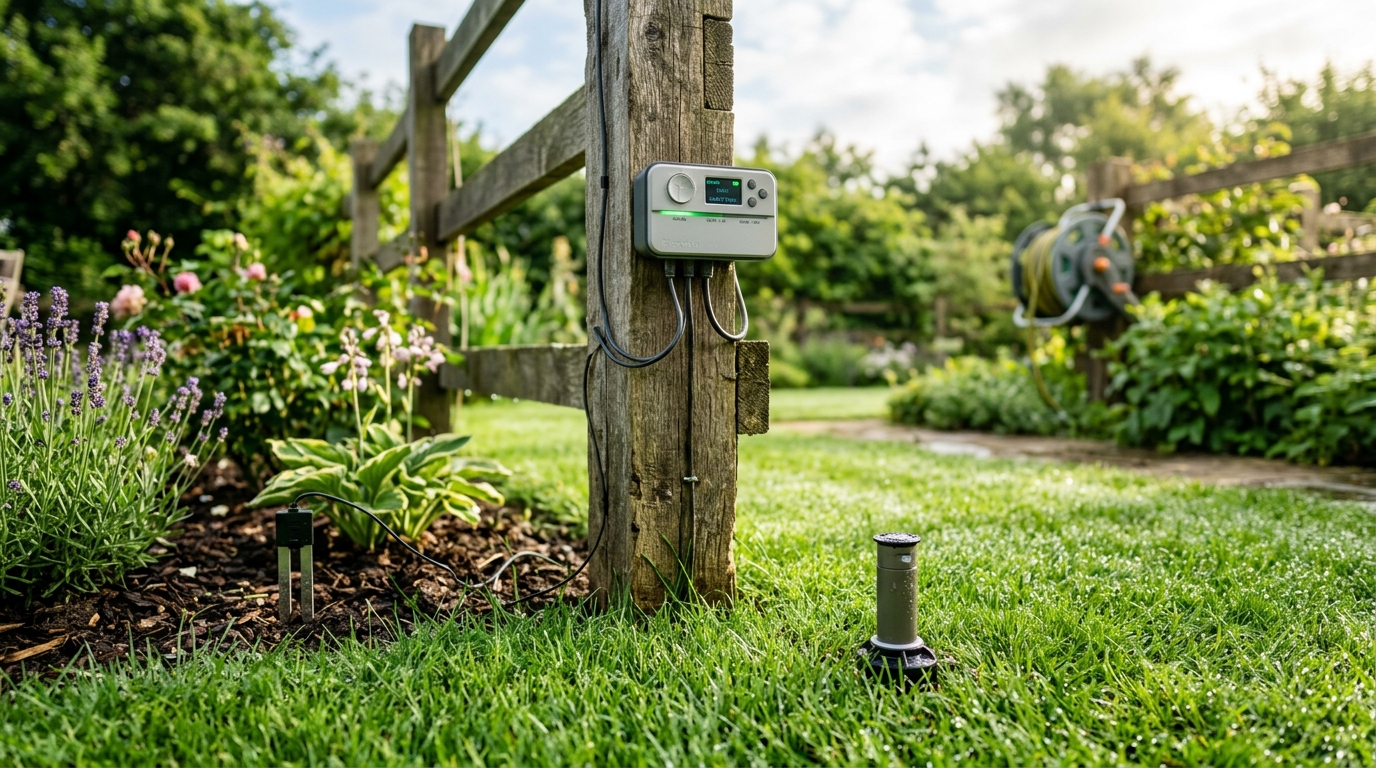
Adding a timer to any irrigation system — even a basic battery-powered tap timer costing $15–$30 — removes the risk of forgetting to turn the water off, allows you to set early morning watering automatically, and ensures consistency even when you are on holiday. Research consistently shows that gardens with automatic timers use significantly less water overall than those watered manually, simply because manual watering tends to be irregular and often excessive when it does happen.
Smart irrigation controllers take this further — connecting to local weather data and soil moisture sensors to adjust watering schedules automatically based on actual conditions. Systems like Rachio, Orbit B-hyve, or RainBird smart controllers cost $80–$200 and can reduce irrigation water use by 30 to 50 percent compared to a standard timer, by suspending watering when rain is forecast and adjusting frequency based on measured evapotranspiration rates.
Water saving potential
Up to 55%
Principle 6: Harvest Rainwater
Free water, right there on your roof
Rainwater harvesting — collecting roof runoff in water butts or storage tanks — is one of the most cost-effective and environmentally sound water sources available to any homeowner. A standard roof of 100 square metres will collect approximately 85 litres of water for every millimetre of rainfall. Even in moderately dry climates, this adds up to thousands of litres of free, unchlorinated water over the course of a growing season.
Plants actively prefer rainwater over tap water. Rainwater is naturally soft, free of chlorine and fluoride, and at ambient temperature — unlike cold tap water, which can shock plant roots in warm weather. Many plants, particularly acid-loving species like rhododendrons, camellias, and blueberries, grow noticeably better when watered with harvested rainwater rather than mains supply.
A basic water butt connected to a downpipe from your roof gutter costs $30–$80 and holds 100–200 litres. For more serious rainwater harvesting, larger storage tanks of 500–5,000 litres are available at correspondingly higher cost, and can be connected to a garden tap or irrigation system. Some homeowners install underground cisterns to store large volumes of winter rainfall for use through the summer growing season — a significant upfront investment that pays back in both water savings and garden resilience.
Water saving potential
Up to 45%
Principle 7: Rethink the Lawn
Lawn is the single biggest water consumer in most gardens
The traditional mown lawn is by far the most water-intensive element of the average residential garden. A healthy lawn in summer can require 25 millimetres of water per week — equivalent to a significant rainfall event — to stay green and vigorous. In hot, dry conditions, maintaining a perfect green lawn can account for 50 to 70 percent of a garden’s total water use.
For many homeowners, reducing or rethinking the lawn is the highest-impact single change available. This does not necessarily mean removing it entirely — but it does mean being honest about how much of your water use is going towards maintaining a grass surface that may or may not be essential to how you use your garden.
Practical lawn water-saving strategies:
- Let it go brown in summer: Lawn grass is remarkably resilient. It goes dormant rather than dead in dry conditions and recovers quickly when rain returns. Accepting summer dormancy and not watering through dry spells is the single biggest water saving available to most homeowners.
- Mow higher: Setting your mower blade to its highest position leaves longer grass blades that shade the soil surface, reducing evaporation significantly. Longer grass also develops deeper roots that access water further down in the soil profile.
- Replace part of the lawn: Converting even a portion of the lawn to drought-tolerant planting, gravel with plants, or a wildflower meadow can reduce your garden’s water consumption dramatically while adding biodiversity and visual interest.
- Choose drought-tolerant grass species: If you are laying a new lawn or overseeding, choose fescue-based mixtures rather than ryegrass or bentgrass. Fine fescues are significantly more drought-tolerant and need far less water to stay green through dry periods.
Water saving potential
Up to 65%
“A water-wise garden is not a compromise — it is a garden designed to thrive on the water nature provides, rather than the water your bill provides.”
Best Drought-Tolerant Plants by Category
Choosing the right plants is the most permanent and lowest-effort water-saving strategy available. Once established — typically after one to two growing seasons — the plants below need little to no supplemental irrigation in most temperate and warm climates.
| Plant | Type | Drought Tolerance | Key Features | Best For |
|---|---|---|---|---|
| Lavender | Shrub / herb | Very High | Silver foliage, fragrant flowers, long season | Borders, edges, pots |
| Rosemary | Shrub / herb | Very High | Evergreen, aromatic, edible, structural | Kitchen garden, hedging |
| Salvia | Perennial | Very High | Long flowering, wildlife magnet, huge variety | Mixed borders, pots |
| Stachys byzantina (Lamb’s ears) | Perennial | Very High | Silver woolly leaves, ground cover, tactile | Front of border, edging |
| Agapanthus | Perennial / bulb | High | Spectacular blue/white summer flowers, strap leaves | Pots, sunny borders |
| Echinacea (Coneflower) | Perennial | High | Bold flowers, autumn seedheads for wildlife, long-lived | Prairie-style borders |
| Sedum / Hylotelephium | Perennial | Very High | Succulent leaves, autumn flowers, winter structure | Rockeries, sunny beds |
| Cistus (Rock rose) | Shrub | Very High | Mediterranean feel, beautiful flowers, evergreen | Hot, dry banks and slopes |
| Ornamental grasses (Stipa, Festuca) | Grass | High | Movement, texture, four-season interest | Mixed borders, slopes |
| Verbena bonariensis | Annual / perennial | High | Tall, airy, self-seeds freely, butterfly magnet | Mixed borders, cutting |
| Thyme | Herb / ground cover | Very High | Aromatic, edible, flowers for pollinators, spreads | Paths, rockeries, kitchen garden |
| Achillea (Yarrow) | Perennial | Very High | Flat-topped flowers in many colours, long season | Borders, wildflower areas |
Water Use by Garden Type: What to Expect
Not all gardens use the same amount of water, and understanding roughly what your current design requires helps you prioritise where the biggest savings are available.
High Water Garden ++Traditional lawn + thirsty annuals + vegetable garden + hanging baskets. Requires regular irrigation throughout summer. Most savings available here.
Medium Water Garden +Mixed border with shrubs and perennials + small lawn + some containers. Needs irrigation in dry spells but can manage moderate drought once established.
Water-Wise Garden ✓Drought-tolerant planting + mulched beds + no lawn or drought-tolerant alternatives + rainwater harvesting. Thrives on natural rainfall in most climates.
Water-Wise Design for the Vegetable Garden
Vegetable gardening presents a particular water challenge because most food crops are genuinely thirsty — especially fruiting vegetables like tomatoes, cucumbers, squash, and courgettes. However, even the vegetable garden can be made significantly more water-efficient without compromising yield.
Water-Saving Strategies for the Vegetable Garden
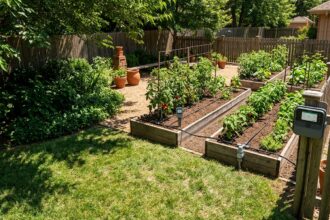
- Use raised beds: Raised beds warm up faster, drain well, and — when filled with compost-rich growing mix — hold water far more effectively than ground-level growing. The compact volume also makes targeted drip irrigation highly efficient.
- Drip irrigation in every bed: A soaker hose laid through each raised bed and connected to a tap timer delivers water precisely to the root zone, eliminating the water waste of overhead watering and the time cost of hand-watering.
- Mulch between rows and plants: Straw mulch between vegetable rows dramatically reduces soil evaporation and suppresses weeds that compete for moisture.
- Group thirsty crops together: Place water-hungry crops (tomatoes, cucumbers, courgettes) together so you can water them intensively without over-watering drought-tolerant crops (herbs, beans, root vegetables) nearby.
- Grow drought-tolerant vegetables: Beans, Swiss chard, kale, beetroot, carrots, and most herbs are significantly more drought-tolerant than tomatoes, cucumbers, and sweet corn. Adjust your crop selection towards these in drier years.
- Water in the morning at soil level: Never water tomato and squash foliage — wet leaves invite fungal diseases. Water at the base, in the morning, and let foliage stay dry.
Common Water-Wasting Mistakes and How to Fix Them
❌ Stop Doing These — They Waste Water and Money
- Watering on a fixed schedule regardless of weather: Turn the irrigation off when rain is forecast. A smart controller does this automatically; a basic timer requires manual override. Watering the day after rain is one of the most common garden water-wasting habits.
- Using a sprinkler in wind: Wind disperses sprinkler water inefficiently, depositing much of it outside the target area. Water on still days or switch to ground-level drip irrigation.
- Watering new plants from above: Newly planted specimens need water directed to their root ball, not to the surrounding soil. Create a shallow dish of soil around each new plant to direct water to exactly where the roots are.
- Keeping bare soil: Bare soil loses moisture to evaporation continuously. Any unplanted area should be mulched immediately.
- Watering containers too little and too often: Containers need thorough watering until water runs from the drainage holes — a small splash on top does nothing. But they also need to partially dry between waterings. Invest in pots with reservoirs or self-watering inserts to reduce frequency dramatically.
- Neglecting leaks and drips: A dripping outdoor tap or a leaking hose connector wastes thousands of litres per year. Check all connections regularly and replace worn washers immediately.
Frequently Asked Questions
The Bottom Line
Water-wise garden design is not a trend or a compromise forced on gardeners by drought conditions. It is simply good gardening — working with natural systems rather than against them, choosing plants suited to your conditions, and applying water where and when it does the most good.
The seven principles in this guide — soil improvement, mulching, plant selection, smart watering practices, efficient irrigation, rainwater harvesting, and rethinking the lawn — work at every scale, every budget, and in every climate. You do not need to implement all of them at once. Start with the one or two that will have the biggest impact on your specific garden, and build from there.
The garden that emerges from this process will be more resilient, more beautiful in its own right, and genuinely less dependent on external inputs — including your time, your effort, and your water bill. In 2026, with water costs rising and climate conditions shifting, that independence is worth a great deal.
Your Water-Wise Action Plan — Start Here
- This weekend: Buy a bag of bark mulch and apply a 4-inch layer to your most exposed garden beds. Immediate impact on evaporation — results visible within days.
- This month: Install a water butt on your main downpipe and a basic tap timer on your outdoor tap. Both take less than an hour and cost under $80 combined.
- This season: Replace three to five thirsty plants with drought-tolerant alternatives from the table above. Each replacement reduces your water demand permanently.
- Next season: Start a compost heap with kitchen scraps and garden waste. In 3–6 months you will have free soil amendment that transforms your garden’s water retention.
- Long-term: Gradually reduce lawn area by converting sections to drought-tolerant planting. Each square metre of lawn replaced saves thousands of litres of water per year.