I used to think a “smart home device” just meant a fancy vacuum that bumped into walls slightly less than the old one. Turns out I was way behind. Spending the last few weeks digging into what’s actually shipping in 2026 completely changed how I think about this category — we’re not talking concepts and CES booth demos anymore. These are real products, with real prices, landing in real homes right now. Here’s what’s genuinely worth knowing.
Robot Vacuums Finally Solved Their Biggest Problem
For years, robot vacuums had one embarrassing weakness: a sock, a phone charger cable, or a stray toy on the floor would either get eaten or just get driven around, leaving a dirty ring behind. That’s changing. Roborock’s Saros Z70 introduced a retractable robotic arm called OmniGrip, designed specifically to clear small objects out of the vacuum’s path — something no other robot vacuum on the market currently offers. It’s not brand new tech at this point, but it’s still the only device doing it this well.
And the innovation hasn’t stopped there. Roborock’s Saros Rover, shown at CES 2026, uses a leg-based system that lets it navigate around obstacles that used to stop earlier models completely — a shoe in the hallway, a chair pulled out from the table, a dog toy left in the middle of the room. Meanwhile, other manufacturers are tackling an even older frustration: new robotic vacuums are being built with mechanical legs or rotating wheel systems specifically so they can climb stairs, meaning a single vacuum could realistically clean multiple floors of a home without help.
The numbers back up how fast this is catching on. Twenty-four percent of US households now own a robot vacuum as of 2026, according to Reviews.org — nearly double what it was back in 2022, and it’s not because prices dropped. It’s because capability jumped: these newer models can do things the earlier generation genuinely could not.
Kitchen and Appliance Tech Is Catching Up Fast
It’s not just vacuums getting smarter. Major appliance makers are pushing hard into fully connected kitchens and laundry rooms. Xiaomi recently expanded its smart home lineup with a large-capacity smart fridge-freezer, a smart washer-dryer, and a new robot vacuum with 15,000 Pa of suction power paired with an automatic cleaning station. The push is part of a broader strategy to make household appliances more interconnected and centrally controllable — the idea being you manage your whole home from one app instead of five.
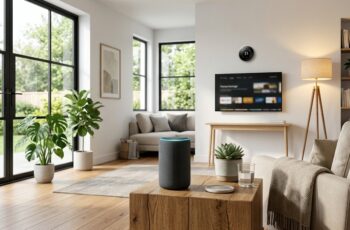
This “everything talks to everything” shift is actually one of the more meaningful changes happening in 2026. For years, smart homes had an annoying catch: your lights needed one app, your camera needed a different one, and your voice assistant frequently refused to cooperate with anything outside its own brand. That’s finally starting to change in 2026, largely thanks to improved cross-brand compatibility standards.
Security-Adjacent Devices Are Having a Big Year Too
Smart home devices and home security are increasingly overlapping categories, and locks are a great example of where the innovation is heading. New smart locks are moving toward battery-free designs and biometric unlocking — face and palm recognition are becoming realistic options instead of gimmicks reserved for sci-fi movies. It’s a meaningful shift for anyone tired of swapping batteries or fumbling with a code pad in the rain.
Smart home security adoption overall sits at around 36% among US households in 2026, which tells you this isn’t a niche interest anymore — it’s becoming a default expectation for a modern home.
What This Means If You’re Just Getting Started
If you’re building out a smart home from zero, here’s the honest advice: don’t try to buy everything at once. Start with whichever device solves an actual daily annoyance for you. If cleaning is your pain point, a robot vacuum with obstacle-avoidance (not just basic mapping) is worth the extra cost — the difference in day-to-day frustration is real. If you’re security-focused, prioritize a lock or camera system that’s part of a broader ecosystem, so you’re not stuck managing five separate apps in six months.
Also worth checking before you buy: many of these devices carry ongoing subscription costs for cloud storage, advanced alerts, or premium automation features, so the sticker price isn’t always the full story. It’s an easy thing to overlook when you’re excited about a shiny new gadget, but it adds up over a year of ownership.
The smart home devices space in 2026 finally feels like it’s delivering on promises that felt years away not long ago — robots that actually navigate real mess, appliances that genuinely talk to each other, and security hardware that’s smarter without being more complicated to use. If you’ve been waiting for this category to mature before jumping in, this might be the year that decision pays off.


)