I used to think soil was just dirt – the stuff plants grow in. If plants weren’t doing well, I’d add more fertilizer or water more frequently, never considering that the problem might be the soil itself. My gardens were okay, but never great. Plants grew, but they struggled more than they should have.
Then I took a soil test and discovered my clay-heavy soil had poor drainage, compacted easily, and lacked organic matter. Once I started actually improving the soil rather than just dumping fertilizer on top of it, everything changed. Plants grew faster, produced more, resisted pests and diseases better, and needed less water.
That experience taught me something every experienced gardener knows: healthy soil creates healthy plants. You can have the best seeds, perfect watering schedule, and ideal sunlight, but if your soil is poor, your plants will struggle. Fix the soil, and suddenly gardening becomes so much easier.
The good news? Improving soil isn’t complicated or expensive. It just requires understanding what your soil needs and giving it those things. This guide covers practical, proven techniques for transforming any soil into rich, productive growing medium that makes your plants thrive.
Understanding Your Soil Type
Before improving soil, you need to know what you’re working with. The three basic soil types each have distinct characteristics and challenges.
Clay soil feels slick and sticky when wet, forms hard clumps when squeezed, and dries into rock-hard chunks. Water drains slowly, and soil stays cold in spring. Clay is nutrient-rich but compacts easily, making it difficult for roots to penetrate and for water and air to move through.
I have heavy clay in parts of my yard. Walking on it when wet creates deep footprints that turn into concrete-hard depressions when dry. Working it when wet is impossible – it just forms sticky balls that cling to tools.
Sandy soil feels gritty, doesn’t hold together when squeezed, and drains very quickly. Water and nutrients wash through fast, so plants need frequent watering and fertilizing. Sandy soil warms quickly in spring (good) but doesn’t retain moisture or nutrients well (challenging).
Loamy soil is the ideal – a balanced mixture of sand, silt, and clay that holds moisture and nutrients while still draining well. It feels slightly gritty but forms a loose ball when squeezed. Most gardens don’t start with loam naturally, but that’s what we’re working toward.
Simple soil test: Take a handful of moist (not wet) soil and squeeze it firmly. Open your hand. Clay soil forms a tight ball that holds its shape. Sandy soil falls apart immediately. Loamy soil forms a ball that breaks apart when gently poked.
pH matters too. Most vegetables and flowers prefer slightly acidic to neutral soil (pH 6.0-7.0). Very acidic or alkaline soil limits nutrient availability even if nutrients are present. Home test kits are inexpensive and eliminate guesswork about whether pH is affecting your plants.
The Magic of Organic Matter
If I could give only one piece of soil improvement advice, it would be this: add organic matter. Lots of it. Regularly. It’s the single most effective thing you can do for any soil type.
Organic matter includes compost, aged manure, shredded leaves, grass clippings, straw, and other decomposing plant and animal materials. As it breaks down, it transforms soil in multiple ways.
In clay soil, organic matter creates spaces between particles, improving drainage and making soil easier to work. It reduces compaction and allows roots, water, and air to move through more easily.
In sandy soil, organic matter acts like a sponge, holding moisture and nutrients that would otherwise wash away. It gives sandy soil more body and substance.
In any soil, organic matter feeds beneficial microorganisms that create healthy soil ecology. It slowly releases nutrients, improves soil structure, and creates the dark, crumbly texture that plants love.
I add two to four inches of compost to my beds every spring. This seems like a lot, but organic matter decomposes continuously, so regular additions maintain soil quality. Over the years, my formerly terrible clay soil has transformed into rich, dark, workable earth.
Compost is decomposed organic matter – nature’s perfect fertilizer and soil conditioner. You can make your own (I do) or buy it bagged or bulk. Quality matters – good compost is dark, crumbly, and smells earthy, not rotting.
Aged manure (from horses, cows, chickens) is nutrient-rich and improves soil structure. It must be aged or composted first – fresh manure is too strong and can burn plants. I get aged horse manure from a local stable and spread it every fall.
Leaf mold is decomposed leaves – excellent soil conditioner though lower in nutrients than compost. I rake autumn leaves into a pile, let them sit for a year, and use the resulting leaf mold as mulch or mixed into soil.
Cover crops (also called green manure) are plants grown specifically to improve soil. Annual ryegrass, clover, and buckwheat grow quickly, then get tilled or dug into soil before flowering. As they decompose, they add organic matter and nutrients.
Dealing With Compacted Soil
Compacted soil is rock-hard, poorly drained, and hostile to plant roots. It happens from foot traffic, heavy equipment, or working soil when wet. Clay soils compact most easily, but any soil can have compaction issues.
Signs of compaction include water pooling on the surface rather than soaking in, hard patches where digging is difficult, poor plant growth despite adequate water and nutrients, and shallow root systems.
Double digging is the traditional solution – removing the top layer of soil, loosening the subsoil beneath with a fork, then replacing and amending the top layer. It’s labor-intensive but effective for severe compaction in vegetable beds.
I’ve double-dug a few beds over the years. It’s hard work but makes a dramatic difference. The loosened soil produces noticeably better crops for several years.
Broadfork is a tool specifically designed for breaking compaction without mixing soil layers. It has long tines that pierce soil, which you then rock back to create cracks and fissures. This improves drainage and root penetration while maintaining soil structure.
Using a broadfork is much easier than double digging and almost as effective. I use mine annually in my vegetable beds before spring planting.
Add organic matter to compacted areas. It won’t fix compaction immediately but gradually improves soil structure as it decomposes. Combined with reduced foot traffic and avoiding working wet soil, organic matter transforms compacted areas over time.
Avoid working wet soil. This is critical for preventing compaction, especially in clay. If soil sticks to tools and boots, it’s too wet to work. Wait until it dries to crumbly consistency.
I learned this the hard way, eagerly digging garden beds too early in spring when soil was still saturated. The compaction I created took seasons to undo.
Create permanent paths so you never walk on growing areas. This single change prevents ongoing compaction. I use wood chips on paths and only walk there, never on beds. My soil stays loose and friable year after year.
Improving Drainage
Poor drainage drowns roots, promotes diseases, and limits what you can grow successfully. If water stands on the surface for hours after rain, or soil stays soggy for days, you have drainage problems.
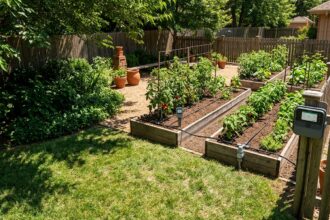
Raised beds are the fastest solution for drainage problems. By building beds six to twelve inches above ground level with good soil, you create growing space that drains well regardless of what’s underneath.
I built raised beds in the lowest, wettest part of my yard. They transformed an area I’d basically written off into productive growing space.
Add organic matter improves drainage over time by creating soil structure with better pore space. In clay, this is especially important – organic matter creates the aggregation that allows water to move through.
Add sand to clay is common advice, but it rarely works as expected. You need to add enormous amounts (50% or more by volume) to make a difference. Lesser amounts often create something resembling concrete. Save yourself the trouble and focus on organic matter instead.
Install drainage tiles or French drains if you have severe, persistent drainage problems. This is more work and expense but permanently solves major issues. I did this in one area and it made that spot usable for the first time.
Create swales or berms to redirect water flow away from growing areas. Even simple grading changes can significantly improve drainage.
Adjusting Soil pH
Soil pH affects nutrient availability. At wrong pH levels, nutrients exist in forms plants can’t absorb even though they’re present. Most vegetables and flowers prefer pH 6.0-7.0.
Test pH using a simple home kit or send samples to a soil testing lab for comprehensive analysis. Testing eliminates guesswork and prevents wasting money on amendments you don’t need.
Raising pH (making soil less acidic) is done by adding lime. Wood ash also raises pH though less predictably. How much to add depends on current pH and soil type – follow test recommendations rather than guessing.
Clay soils need more lime than sandy soils to change pH by the same amount. Apply lime in fall if possible, as it works slowly – several months to take full effect.
Lowering pH (making soil more acidic) requires sulfur or acidifying fertilizers like ammonium sulfate. This is less common than raising pH in most areas. Organic matter like pine needles and peat moss slightly acidifies soil over time.
Some plants prefer specific pH. Blueberries need acidic soil (pH 4.5-5.5). Brassicas prefer slightly alkaline conditions. Most plants tolerate a fairly wide range, but knowing preferences helps you group plants appropriately.
Building Soil Fertility
Nutrients are critical, but there’s more to fertility than just nitrogen, phosphorus, and potassium (NPK).
Soil test reveals what nutrients your soil has and lacks. This is far more useful than guessing or blindly applying fertilizer. Many extension offices offer testing services for minimal cost.
I test soil every few years, and the results always surprise me. Sometimes nutrients I thought were deficient are actually adequate. Other times I discover unexpected deficiencies.
Organic fertilizers release nutrients slowly as they decompose, feeding soil life and plants together. Options include compost, aged manure, bone meal (phosphorus), blood meal (nitrogen), kelp meal (trace minerals), and rock phosphate.
I primarily rely on compost and aged manure for fertility. They provide balanced nutrition plus organic matter and microbial activity.
Synthetic fertilizers provide nutrients immediately but don’t improve soil structure or biology. They have their place but shouldn’t be your only fertility source. Used alone, they create dependence – soil becomes biologically depleted and requires increasing fertilizer inputs.
Crop rotation helps maintain soil fertility by varying the nutrient demands placed on soil. Heavy feeders like tomatoes followed by light feeders like beans prevents depleting specific nutrients.
Cover crops add fertility, especially legumes like clover and vetch that fix atmospheric nitrogen. I plant crimson clover in fall vegetable beds, let it overwinter, then turn it under in spring.
Nurturing Soil Biology
Healthy soil teems with life – bacteria, fungi, earthworms, nematodes, and countless other organisms. These creatures are what make soil alive rather than just a growing medium.
Soil microorganisms break down organic matter, cycle nutrients, suppress diseases, and create soil structure. They’re more important than most gardeners realize.
Feed soil life by adding organic matter regularly. Microorganisms need food (carbon) just like plants need nutrients. Compost, mulch, and cover crops all feed soil biology.
Avoid disturbing soil excessively. Tilling disrupts fungal networks and can harm soil structure. No-till or minimal-till approaches preserve soil biology better than frequent cultivation.
I’ve shifted toward less tilling over the years. I still turn soil in spring for vegetable beds, but I don’t till as deeply and I never till more than necessary.
Maintain consistent moisture. Soil biology slows dramatically when soil dries completely. Mulching helps maintain the consistent moisture that keeps microorganisms active.
Avoid synthetic pesticides when possible, as they can harm beneficial soil organisms along with target pests. Organic pest control methods are generally safer for soil life.
Earthworms are indicators of healthy soil. Their tunnels improve drainage and aeration, and their castings are excellent fertilizer. Presence of abundant earthworms indicates you’re doing things right.
Mulching for Soil Health
Mulch is any material spread on soil surface. Organic mulches decompose over time, adding organic matter and nutrients. They’re one of the easiest, most effective ways to improve soil.
Benefits of mulching:
- Conserves moisture by reducing evaporation
- Moderates soil temperature
- Suppresses weeds by blocking light
- Prevents erosion and soil compaction from rain impact
- Adds organic matter as it decomposes
- Feeds soil microorganisms
- Keeps plant leaves clean by preventing soil splash
I mulch everything – vegetable beds, flower gardens, around trees and shrubs. It’s saved me countless hours of weeding and watering.
Organic mulches include shredded leaves, straw, wood chips, grass clippings, and compost. Different materials have different characteristics:
Shredded leaves are free if you have trees, decompose in one season, and improve soil beautifully. I use these extensively.
Straw is clean, light-colored (so it doesn’t absorb heat), and perfect for vegetable gardens. Avoid hay, which contains weed seeds.
Wood chips last longer than other mulches, making them economical for paths and around permanent plantings. They tie up nitrogen temporarily as they decompose, so add extra nitrogen when using them in growing areas.
Grass clippings are free and nitrogen-rich, but they mat down and can smell if applied too thickly. Use thin layers or mix with other materials.
Apply mulch two to four inches thick after soil warms in spring and plants are established. Too early in spring and mulch keeps soil cold. Too thick and it can create problems.
Keep mulch a few inches away from plant stems and tree trunks to prevent rot. Don’t pile it against stems like a volcano – that’s asking for problems.
Long-Term Soil Building
Improving soil isn’t a one-time project – it’s an ongoing process. The good news is that soil improves cumulative over the years as you continue good practices.
Year one: Add lots of organic matter, address major drainage or compaction issues, test and adjust pH if needed.
Year two: Continue adding organic matter, observe how plants respond, fine-tune practices based on results.
Year three and beyond: Soil steadily improves. Plants grow better with less intervention. You develop intuition about what your soil needs.
My soil today compared to when I started gardening is dramatically different. Dark, crumbly, sweet-smelling, full of earthworms – it’s become the rich soil I initially thought only lucky gardeners inherited.
The Foundation of Great Gardening
Every experienced gardener will tell you the same thing: take care of your soil and your soil will take care of your plants. It’s not the exciting part of gardening – choosing seeds and harvesting vegetables is more fun – but it’s the foundation everything else builds on.
Start by understanding what soil type you have and what it needs. Add organic matter generously and regularly. Address major problems like compaction, drainage, or pH. Feed soil life as much as you feed plants.
Do these things consistently, and over time you’ll create the dark, rich, living soil that makes great gardens possible. Your plants will grow stronger, produce more, and require less intervention because they have the foundation they need to thrive.
Good soil isn’t something you’re born with or lucky enough to have – it’s something you build, season by season, through simple practices applied consistently. Start today, and you’ll be amazed at the transformation that unfolds.